Denver League members and guests joined our January Briefing on Water Management, introducing and exploring the nuances of Denver’s complex water resource issues while recognizing the many diverse stakeholders who rely on the Colorado and other rivers for Denver residents’ water consumption and food production. Denver Water staffers, Bea Stratton and Andy Hill, described some of Denver’s challenges. One is that 80% of Colorado’s water sources come from the western slope, yet 80% of Colorado’s population lives east of the Continental Divide. Denver’s water source is equally from the Colorado River Basin and the South Platte River Basin, 50% from each.
We were reminded that a 1922 water compact agreement among Colorado River Upper and Lower Basin users (seven states) is due to expire this fall. After 104 years, it is apparent that changes are necessary that reflect current conditions. For example, the 1922 agreement allocates Colorado River water to only 22 Tribal Nations. Now 30 are rightfully federally recognized in the Colorado River Basin, in addition to the seven states and Mexico who share the available water. Unbelievably, there are still communities within this region who do not have access to clean, reliable drinking water.
According to Colorado’s Commissioner on the Upper Colorado River Commission, “The Colorado River is not broken, but we are. The river is doing exactly what rivers do when you take too much from them for too long.” Besides praying for more precipitation in Colorado this spring, keep an eye out for the U.S. Secretary of the Interior’s call for public comments on how to update the 1922 Colorado River Basin Compact. Rather than viewing our rivers as a resource or entitlement, let’s help craft a new agreement that appreciates the vital role our rivers play in sustaining ecosystems and cultures.
Denver Water provides water to 25% of the state’s population using 2% of its water. This is a good sign of efficiency, but more needs to be accomplished.
Denver Water is encouraging Denvervites to transition their non-functional turf grass to a functional ColoradoScape - a water-wise, climate-resilient form of landscaping that provides many benefits to our communities like water savings, soil improvement, wildlife and pollinator support, and diversity. This is a part of their conservation effort to reduce non-functional turf by 30%. Differentiating between functional and non-functional is simple. Functional turfgrass provides benefits to communities - think parks, sports fields, and grassy recreation areas for families and dogs. Non-functional areas are primarily only being stood on to be mowed - think large swaths of grass in medians and along roadways.
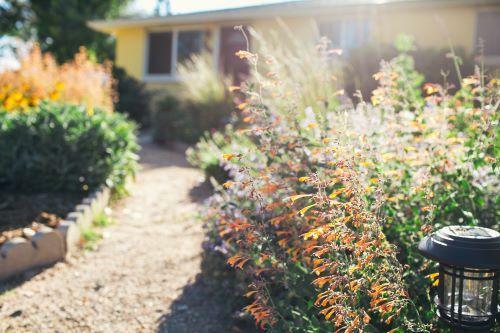 Photo credit: Resource Central
Non-functional turf are lawns that “only see the underside of a lawn mower,” such as parking strips. Instead of installing rocks or cacti (zero-scape instead of xeriscape), the goal to plant drought-tolerant, climate resilient landscaping while also protecting our tree canopy. Functional turf grass (recreational uses and lawns used by children, adults, or pets) is not eliminated. For an example of the combined use of functional and non-functional turf, take a walk through Washington Park’s formal gardens along South Downing Street that have been replanted with native and other drought tolerant plantings.
Multiple incentives and services are available to encourage Denver Water users to reach this non-functional turf goal, such as $750 discount for turf removal, or $25 off Resource Central Garden-in-a-Box kits, or free “Slow the Flow” irrigation audits. To assist users, a free "Do It Yourself (DIY) Landscape Transformation Guide" is ready for downloading from their
website. For HOA, commercial or community projects, Denver Water’s Landscape Transformation Assistance program provides funding if you have an area of non-functional turfgrass you want to transition to a water-wise ColoradoScape .
Sarah O. McCarthy, Co-Director of Program and Advocacy